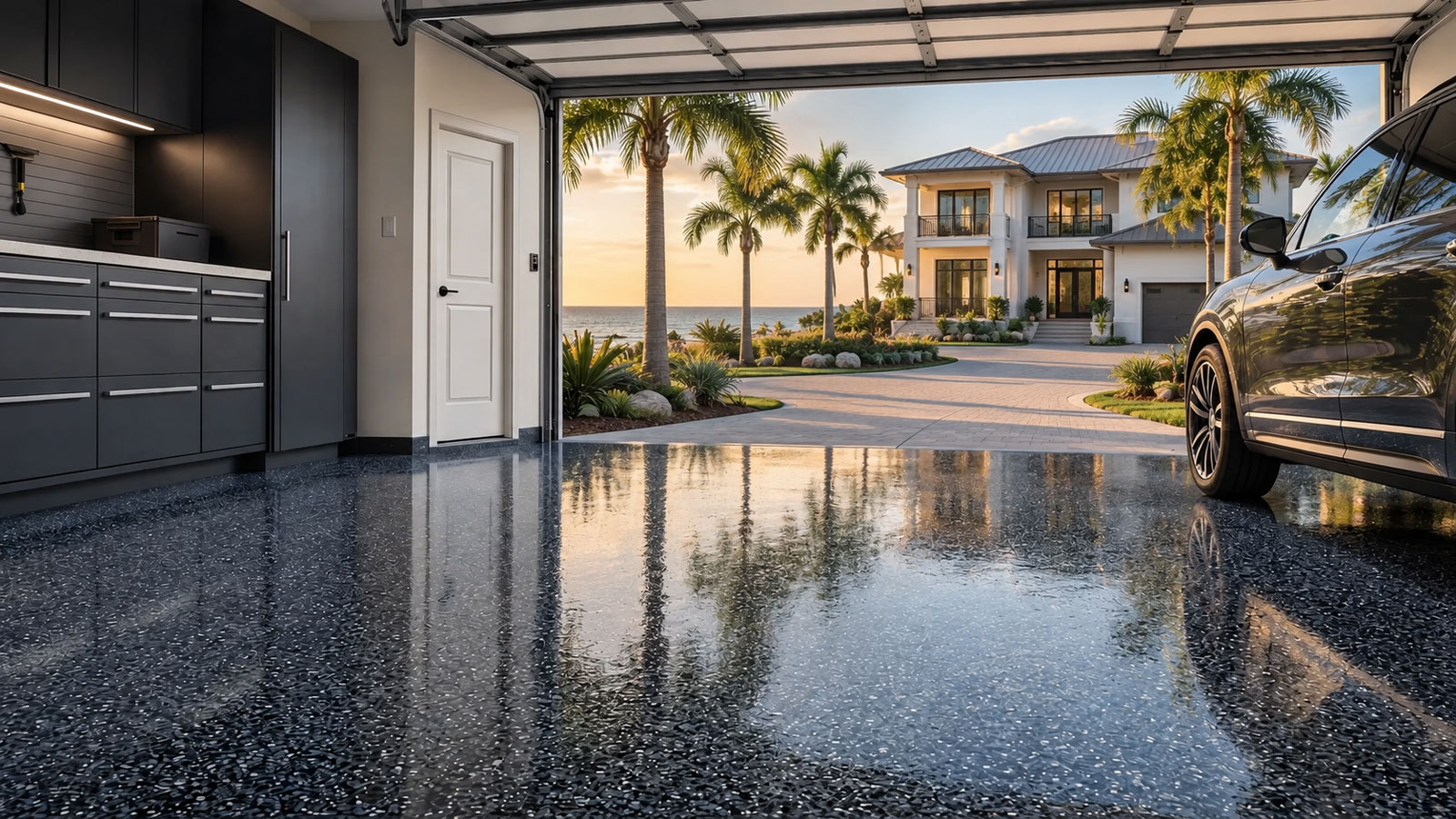
Garage Floor Coating in Port Charlotte, FL
Floor Coating Services in Port Charlotte, FL
Port Charlotte's garage coating market has a specific government and drainage context. Charlotte County Public Works records that Port Charlotte is unincorporated and served in part by Greater Port Charlotte Street and Drainage benefit units. This official observation is locally meaningful but does not identify the condition of concrete in any one garage. The presence of canals, utility funds or swales should prompt questions about the real driveway and door threshold, not a generalized recommendation for moisture barriers or a particular resin system.
A second set of records explains the Mid-Charlotte Stormwater Utility was established through Ordinance 01-030 in 2001. In addition, the county identifies ditch maintenance, deteriorated control-structure replacement and water-quality monitoring as stormwater responsibilities. These facts distinguish the setting from other communities along the Sarasota–Charlotte corridor. A homeowner should separate water tracked inside with a vehicle from recurring flow crossing a driveway apron or persistent dampness within concrete. Do not call Port Charlotte a city with its own council or municipal stormwater ordinance.
For unincorporated neighborhoods with roadside ditches and driveway culverts, actual slab soundness determines preparation. Old floor paint, sealer, tire residue, oil stains, repaired sections and cracks must be evaluated before a contractor chooses mechanical grinding or resin. Sunshine at the doorway, hot tire parking, texture, movement joints and the time before vehicles return also matter. Properly bonded epoxy or polyaspartic can make normal cleaning easier but is not a fix for outside drainage or harbor flooding.
Local Market Insight
Charlotte County Public Works documents that Port Charlotte is unincorporated and served in part by Greater Port Charlotte Street and Drainage benefit units; the Mid-Charlotte Stormwater Utility was established through Ordinance 01-030 in 2001. For a homeowner, those are reasons to distinguish driveway runoff and concrete repairs before coating, not proof that every Port Charlotte garage is damp.
What Affects the Cost of Garage Floor Coating in Port Charlotte?
A coating proposal for Port Charlotte should begin with benefit-unit boundary and private culvert conditions. Port Charlotte is unincorporated and served in part by Greater Port Charlotte Street and Drainage benefit units. That infrastructure fact can change inspection questions, but its mere existence does not establish any private concrete moisture condition or an automatic remediation cost.
Charlotte County Public Works records that Port Charlotte is unincorporated and served in part by Greater Port Charlotte Street and Drainage benefit units. This is useful when defining the scope of a Port Charlotte garage estimate, not a basis for a citywide price premium. The published $6–$12 per-square-foot and $3,000–$5,500 typical two-car ranges are planning references only. Ask the bidder to itemize removal, grinding, any repairs and the full coating system before treating a quote as comparable.
Garage floor coating prices can vary from one Port Charlotte home to another. The size of the garage matters, but so does the condition of the concrete, the amount of preparation needed, and the type of coating or finish you choose. A professional installer usually needs to see the floor before giving an accurate quote.
- Official water infrastructure: Port Charlotte is unincorporated and served in part by Greater Port Charlotte Street and Drainage benefit units. A public or historical stormwater program does not diagnose slab moisture or eliminate the need for observing door-line runoff.
- Drainage maintenance jurisdiction: the Mid-Charlotte Stormwater Utility was established through Ordinance 01-030 in 2001. Determine whether a condition involves the county, city, special district, HOA or private owner before incorporating anything into a garage-floor estimate.
- Documented projects and design: the county identifies ditch maintenance, deteriorated control-structure replacement and water-quality monitoring as stormwater responsibilities. These are infrastructure details, not proof that the chosen garage coating will correct surface-water entry or flooding.
- Existing concrete and repairs: For unincorporated neighborhoods with roadside ditches and driveway culverts, inspect old floor paint, sealers, oil, concrete patches and cracks; specify removal and mechanical profiling to reach sound substrate.
- Threshold and movement joints: The presence of canals, utility funds or swales should prompt questions about the real driveway and door threshold, not a generalized recommendation for moisture barriers or a particular resin system. For a Port Charlotte floor project, this distinction requires inspecting the actual garage doorway after rainfall rather than assuming public drainage predicts indoor conditions. Water carried in by tires, flow crossing a driveway lip and concrete that remains damp have different causes. Document them before any moisture-related product is proposed, and keep exterior drainage corrections separate from the finish.
- Finish, UV and downtime: In addition, the county identifies ditch maintenance, deteriorated control-structure replacement and water-quality monitoring as stormwater responsibilities. For a garage in Port Charlotte, the relevant choice is the system specified for the existing slab, not the area's name. Discuss contamination and prior repairs first, then UV at the door, traction for wet shoes, cleaning habits and the manufacturer's application and vehicle-return limits. A decorative resin finish cannot compensate for unsupported concrete or for water entering from outside.
Call for a clear, project-specific estimate — or request one online.
Port Charlotte's Water Infrastructure and the Garage-Door Boundary
Charlotte County Public Works provides distinct official context: Port Charlotte is unincorporated and served in part by Greater Port Charlotte Street and Drainage benefit units. This is more useful than a generic assertion about Southwest Florida humidity because the relevant authority, time period or facility is identifiable. It still describes public infrastructure or regional geography, not how water or vapor behaves in a particular garage slab.
The additional documentation states the Mid-Charlotte Stormwater Utility was established through Ordinance 01-030 in 2001. The homeowner's practical question is benefit-unit boundary and private culvert conditions. Observe whether rainwater flows across the driveway lip after a storm, whether a door seal leaks or whether a puddle appears only after parking a wet vehicle. These are different conditions and do not all require the same coating response.
the county identifies ditch maintenance, deteriorated control-structure replacement and water-quality monitoring as stormwater responsibilities. This further anchors the community's stormwater program, but a coating installer should not assume a nearby project protects an entire neighborhood or that historic asset counts are current. Do not call Port Charlotte a city with its own council or municipal stormwater ordinance.
A homeowner should separate water tracked inside with a vehicle from recurring flow crossing a driveway apron or persistent dampness within concrete. For a Port Charlotte floor project, this distinction requires inspecting the actual garage doorway after rainfall rather than assuming public drainage predicts indoor conditions. Water carried in by tires, flow crossing a driveway lip and concrete that remains damp have different causes. Document them before any moisture-related product is proposed, and keep exterior drainage corrections separate from the finish.
Concrete Preparation and Practical Garage Use in Port Charlotte
Garage properties in unincorporated neighborhoods with roadside ditches and driveway culverts may have varied construction and remodeling histories. A slab can have previous floor paint, oil staining, patch compounds or concrete poured later than the main home. Appearance alone is not evidence that the surface will bond to a new epoxy or polyaspartic assembly.
For unincorporated neighborhoods with roadside ditches and driveway culverts, actual slab soundness determines preparation. The corresponding garage inspection should identify old paint and sealers, contaminated areas, patch compounds and the profile of sound concrete. Stable repairs and movement joints must be handled differently. Ask which areas near steps, shelving and edges are included in preparation and what happens if grinding exposes a weak prior finish.
Seasonal storms mean tracking of water and grit is expected, yet the presence of benefit-unit boundary and private culvert conditions should not be interpreted as a universal slab-moisture problem. If outside water repeatedly enters, address the actual source separately. A new resin floor may make ordinary tire-mark and dust cleanup easier after proper installation, but it cannot redirect municipal runoff.
Compare named primer, base and topcoat materials, UV stability where the open door admits sunlight, traction for wet shoes, hot-tire performance and the manufacturer's application and cure constraints. Do not call Port Charlotte a city with its own council or municipal stormwater ordinance. Require an explicit return-to-foot-traffic and return-to-vehicle schedule before accepting a quote.
Frequently Asked Questions
Does Port Charlotte's stormwater infrastructure mean my slab needs a moisture barrier?
No. Port Charlotte is unincorporated and served in part by Greater Port Charlotte Street and Drainage benefit units. This is Charlotte County Public Works planning context, not a moisture reading on your concrete; inspect actual dampness or prior coating failure at the property.
What drainage responsibility is distinctive in Port Charlotte?
the Mid-Charlotte Stormwater Utility was established through Ordinance 01-030 in 2001. Local maintenance jurisdiction may differ from private driveway and threshold responsibilities; a coating does not correct an exterior water path.
Are there important local projects or rules to know about?
the county identifies ditch maintenance, deteriorated control-structure replacement and water-quality monitoring as stormwater responsibilities. Their application is site- or jurisdiction-specific, so do not assume every garage shares the same water exposure or construction requirements.
Can a painted or repaired garage floor receive new epoxy immediately?
Sunshine at the doorway, hot tire parking, texture, movement joints and the time before vehicles return also matter. In comparing Port Charlotte proposals, confirm old-finish removal and mechanical grinding, repair limits, movement-joint treatment, threshold work and the exact primer and topcoat materials. Exposure to sunlight at the opening, texture and the time vehicles must remain outside should be written into the scope rather than left to a generic product label.
What should a Port Charlotte garage-floor quote spell out?
Charlotte County Public Works documents that Port Charlotte is unincorporated and served in part by Greater Port Charlotte Street and Drainage benefit units; the Mid-Charlotte Stormwater Utility was established through Ordinance 01-030 in 2001. The corresponding garage inspection should identify old paint and sealers, contaminated areas, patch compounds and the profile of sound concrete. Stable repairs and movement joints must be handled differently. Ask which areas near steps, shelving and edges are included in preparation and what happens if grinding exposes a weak prior finish.
Port Charlotte Neighborhoods & Local Context
Phone Quote Line
Call to discuss your project, concrete condition, and a realistic estimate range.
(941) 941-9870Typical Project Cost
$3,000–$5,500
Planning range for a typical two-car garage. Final pricing depends on floor size, concrete condition, prep work, coating type, and finish options.
Helpful Guides
Other Service Areas